

Match preview · Kickoff:
Statistical context: API-Football · checked . Historical lineups are not confirmed starters.
Why this match matters
This derby matters because it is a meeting of two clubs with very different early-season shapes, not just two names with long history. Manchester City are top of the league table with nine points from three, and their league wins have come with only two goals conceded. Manchester United are 11th with four points from three, but their home record is stronger than their away record and they have already shown they can score heavily at Old Trafford. That combination makes the game important as an early read on whether United can close the gap in the league’s top tier, and whether City can keep their perfect start intact in a ground where the emotional pressure is always amplified.
The home side: form and context
Manchester United’s recent results are mixed rather than disastrous, but the sample still tells a useful story. Across eight last completed matches in all competitions, they have three wins, one draw and four losses; within the Premier League only, they have one win, one draw and one defeat. The home sample is the key one: one league home game, one win, five goals scored and two conceded. That is too small to prove a stable home identity, but it does show United have been much more productive at Old Trafford than away, where they have two league trips and only two goals scored. The 4-0 Champions League win over Sabah adds confidence, yet it came against different opposition and a different competition context, so it should be treated as form, not proof of a repeatable ceiling.
The away side: form and context
Manchester City’s early league profile is sharper, even with the same small-season caveat. They have won all three Premier League matches, with three goals scored at home and four away, and only two conceded overall. Their away league numbers are especially strong in output: one away game, one win, four goals scored and one conceded. In the wider eight-match sample they have seven wins, one draw and no defeats, but that includes the Community Shield loss to Arsenal, so competition matters. The recent Champions League win at Porto, where they had 64 percent possession, 20 shots and a 2.32 xG return according to API-Football, suggests they can still control a match away from home when the opponent allows them time on the ball.
Home build-up against the away defence
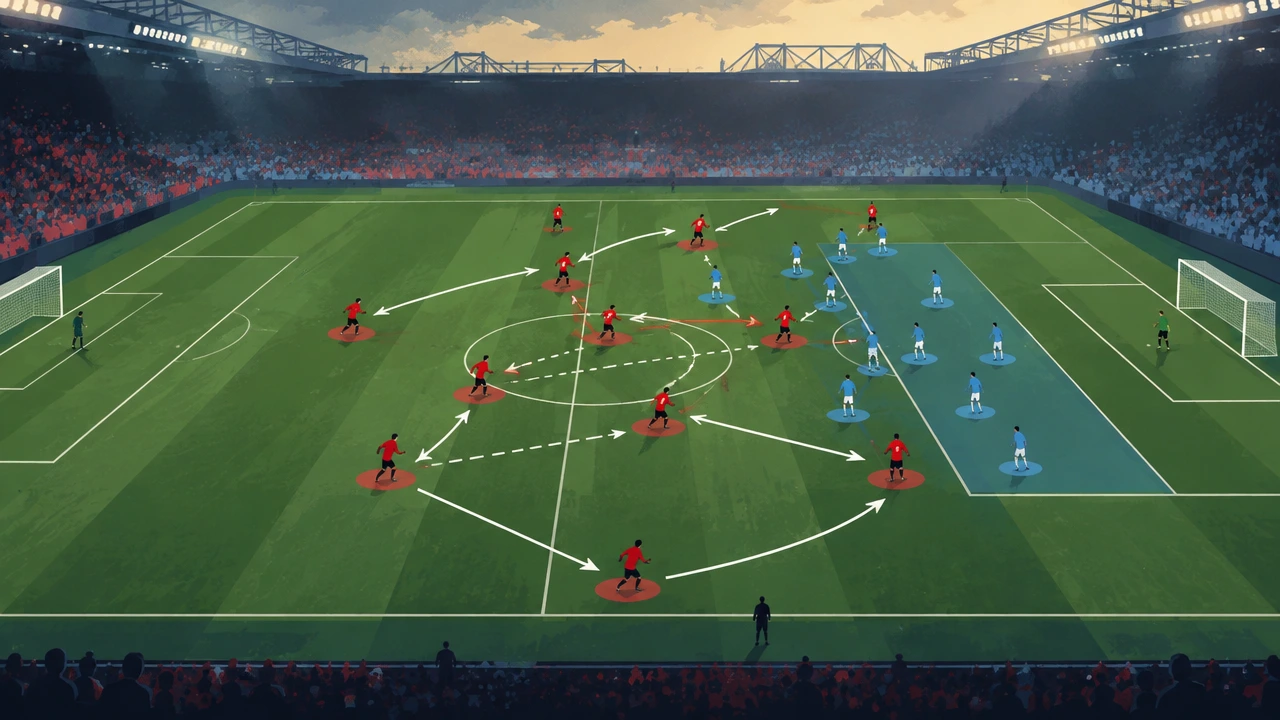
United’s build-up against City’s defence looks like a contest between volume and restraint. The only reliable observation from the research is that United generated 33 shots and 4.56 xG against Ipswich at home, then followed that with 21 shots and 58 percent possession against Sabah, while City have generally been more compact defensively in league play. That suggests United can create pressure at Old Trafford if their circulation is clean enough to get into the box rather than settle for lower-value attempts. The tactical question is whether they can do that without leaving themselves stretched when possession turns over. A useful signal to watch is how often United can combine through the central lanes before the final pass; if those actions become rushed or wide, City’s back line should feel more comfortable.
Away build-up against the home defence
City’s build-up against United’s defence is likely to be more controlled, but not automatically more dominant. Their league away sample is small, yet the figures are encouraging: 72 percent possession and 2.21 xG at Crystal Palace, then 64 percent possession and 2.32 xG at Porto in midweek. That does not prove a single system, but it does indicate that City can sustain long attacking sequences and still create chances from possession. Against a United side that has conceded four league goals away from home and has injury uncertainty in central and wide areas, the main interaction may come through patience rather than pace. Watch whether City can keep United’s midfield pinned back long enough to force the hosts’ full-backs into deeper starting positions.
Transitions and set pieces
Transitions and set pieces may decide whether this game stays open or becomes controlled. United have scored heavily at home in the league but also conceded twice in that Ipswich match and twice at Everton, which hints that they can be reached when the game breaks into repeated exchanges. City have not been overwhelmed in any league match so far, but their only defeat in the broader sample came in the Community Shield, a reminder that disruption can still matter against them. Set-piece data here is too limited to claim an edge either way, so the safer reading is that dead-ball moments will matter because they create short, high-leverage possessions in a derby where settled attacking patterns may be harder to sustain. Watch the first five or six corners and free kicks for clues about which side is winning territory.
Team news and lineup uncertainty
Team news points toward more uncertainty on the United side. API-Football lists Tom Heaton, Manuel Ugarte and Matthijs de Ligt as missing, with Carlos Baleba and Amad Diallo questionable. The Standard reported Luke Shaw as a possible derby return after missing the Sabah match, while Patrick Dorgu filled in at left-back and was credited with the official UEFA player of the match award. For City, Jeremy Doku is reported out and Nico O’Reilly has been described as 100 per cent available. Those reports matter because they affect how each team can structure its wide play and midfield support, but none of them confirm a starting XI. The key uncertainty is whether United’s left side is physically and tactically ready for a game in which City can keep the ball for long stretches.
The decisive matchups
The decisive matchups are less about a single named duel than about unit against unit. United’s left flank, especially if Shaw is not fully ready, will have to deal with City’s right-sided attacking support and a midfield that has already shown it can feed the box from controlled possession. At the other end, City’s central defenders and screening midfielders will need to handle Bruno Fernandes and the runners around him, because United have repeatedly been able to create shot volume at home when their passing reaches the final third early. Another important matchup is freshness: BBC Sport noted City have two more days of rest after Porto than United have after Sabah, and that can influence late-game structure, pressing recovery and substitution timing rather than just initial energy.
Three ways the game could unfold
There are three broad ways this derby could unfold. One, City settle the ball early, keep United’s front line chasing and gradually build territorial pressure until the hosts are forced into longer clearances and fewer attacks through midfield. Two, United turn Old Trafford into a faster, more direct game, using their home shot volume and crowd energy to create a sequence of chances before City fully impose control. Three, the match becomes fragmented, with injuries, rest differences and the two managers’ in-game adjustments producing a stop-start derby where one set-piece or one transition changes the balance. None of these scenarios requires a score prediction to be useful; each is a different path through the same evidence.
What to watch from kickoff
What to watch from kickoff at Old Trafford on Sunday 13 September 2026, 18:30 Europe/Istanbul time, is the first ten-minute rhythm. If United can connect enough passes to pin City back and create early box entries, the home crowd may drag the game toward their preferred tempo. If City start by keeping the ball through their midfield pair and denying United direct exits, the visitors can make the extra rest count. Also watch the left side of United’s defence, where selection uncertainty and City’s ability to rotate possession into wide areas could quickly reveal whether this is a derby of sustained pressure or one of reactive defending. The opening patterns should tell us which side has better control of the middle of the pitch.
Why it matters
The matchup is shaped less by reputation than by current availability, rest and recent production. City’s early-season stability has been backed by cleaner away numbers in the league, while United’s home threat has been stronger than their away form. The derby may hinge on whether United can turn home possession into sustained pressure without exposing space for City’s controlled attacking patterns.
What remains unconfirmed
- Whether Luke Shaw will start for United.
- Whether Nico O’Reilly will start for City.
- Whether Carlos Baleba or Amad Diallo will be involved.
- Whether either team will use the same formation as in historical lineups.
- How the derby will be played tactically beyond the observed recent numbers.
- The final score or any specific match outcome.
Established facts
- Manchester City lead the Premier League with 9 points from 3 matches and Manchester United are 11th with 4 points from 3 matches.
- The fixture is Manchester United vs Manchester City at Old Trafford on 2026-09-13, kickoff 15:30 UTC / 18:30 Europe/Istanbul.
- API-Football lists United with one home league win from one, five goals scored and two conceded at home; City with two home league wins and one away league win from three total, seven goals scored and two conceded.
- United’s listed league formation is 4-2-3-1 in their recent samples; City’s listed league formation is 4-2-3-1 in their recent samples.
- BBC Sport reported City have two extra days of rest compared with United before the derby.
- The Standard reported Jeremy Doku is ruled out and Nico O’Reilly is available for City.
- The Standard reported Luke Shaw may be in contention for United, while Baleba is unlikely to be involved and Dorgu covered left-back against Sabah.
- API-Football match stats show United had 33 shots and 4.56 xG against Ipswich at home, and City had 20 shots and 2.32 xG at Porto away.
Our assessment
City have the cleaner early season base, but United’s home output and derby setting give them a real route into the game if they can protect the left side and keep City’s midfield circulation from settling.